CNC Machine Tending & Automated Part Handling
Industrial Components Manufacturer
How an industrial components manufacturer automated raw material loading, finished part handling, and quality verification using Standard Bots RO1 cobots and ROS-based orchestration.
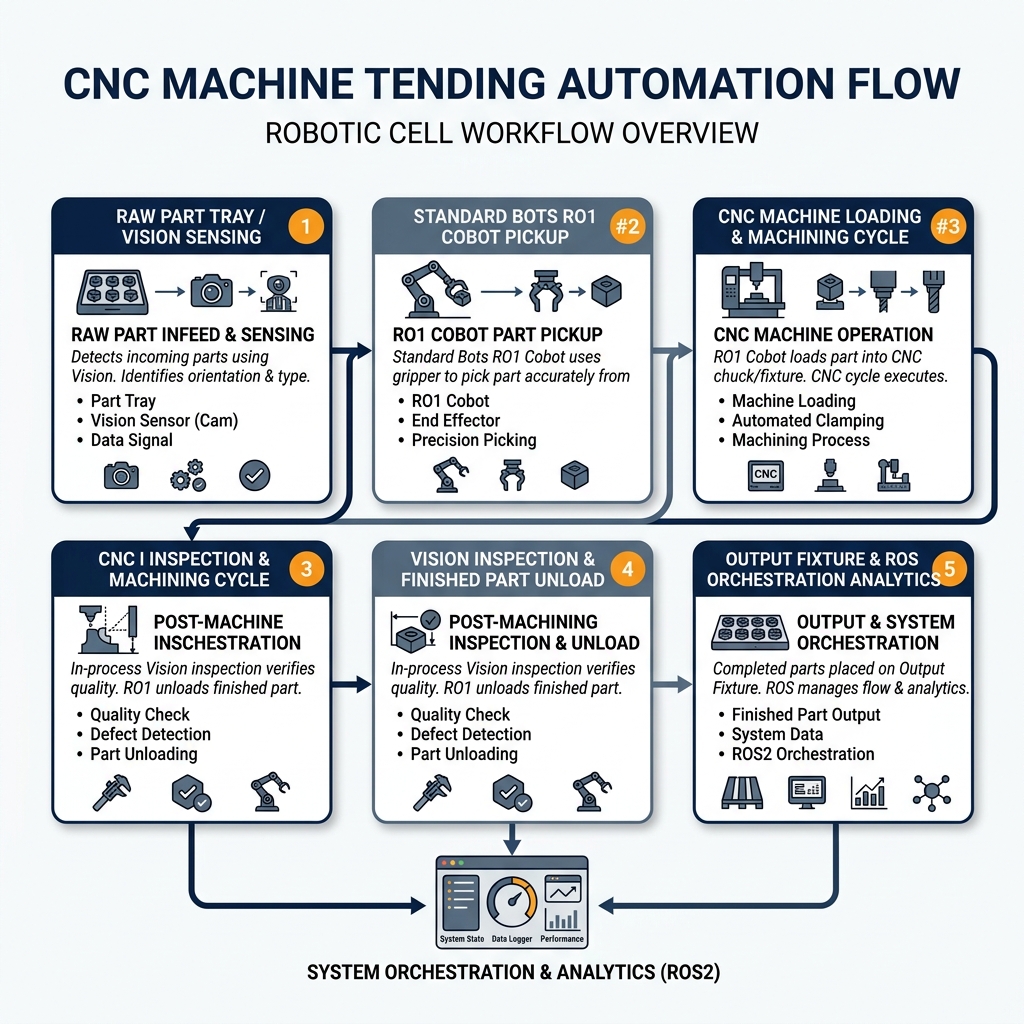
Process Visualization
The Challenge
A precision components facility relied on skilled operators to manually load raw parts into CNC machines, initiate machining cycles, and unload finished parts. Operator availability during shift changes, breaks, and labor shortages led to machine idle time and reduced output across expensive CNC equipment.
The Solution
We engineered a flexible robotic tending cell utilizing the Standard Bots RO1 cobot, integrated vision systems, and ROS-based orchestration. The system autonomously manages the full sequence from component identification to CNC loading and unloading.
Implementation
Workflow assessment analyzing machine cycle times, payloads, and cell footprint
Standard Bots RO1 platform evaluation and proof of concept validation
Robotic cell design and custom end-effector selection for multi-part handling
Vision system, sensor feedback, and ROS orchestration software development
Controlled pilot validation, fail-safe exception logic testing, and operator training
Impact & Results
Operational Impact
- Achieved consistent machine cycle times independent of operator presence
- Integrated automatic sensor verification for component availability and grip safety
- Zero damage to precision components through repeatable robotic handling
Business Impact
- Significantly increased CNC machine utilization and overall output capacity
- Reallocated skilled machinists to setup, quality inspection, and process optimization
- Eliminated production downtime caused by operator shift gaps and breaks
Strategic Impact
- Established an agile collaborative robotics model scalable to additional CNC cells
- Avoided costly custom traditional automation by leveraging flexible cobot architecture
- Enhanced workplace ergonomics and safety by eliminating heavy repetitive handling