Autonomous Material Movement in Manufacturing
Manufacturing & Intralogistics Enterprise
How a manufacturing facility automated internal material transport using Collaborative Robotics' Proxie platform, replacing repetitive cart pushing with intelligent, event-driven intralogistics.
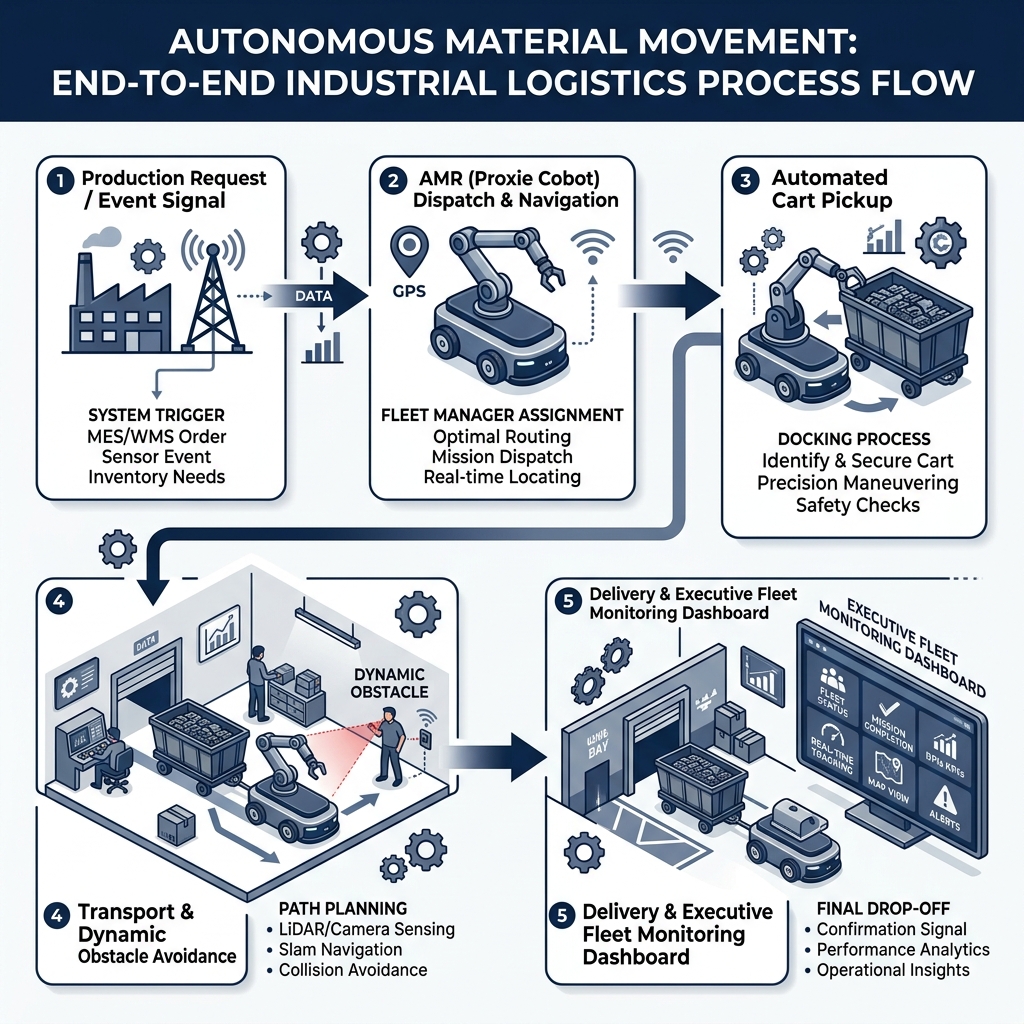
Process Visualization
The Challenge
Employees in a large manufacturing facility spent significant operational hours manually pushing carts of materials, parts, work-in-progress inventory, and empty containers across long distances. This created manpower dependencies, inconsistent station supply times, and production line starvation without altering physical facility infrastructure.
The Solution
We deployed Collaborative Robotics' Proxie AMR platform to handle repetitive material transport routes autonomously. Integrated into the facility event stream, the robots respond dynamically to station replenishment requests and material readiness signals.
Implementation
Facility material-flow mapping and high-frequency route identification
Proxie platform evaluation for navigation, safety, and cart compatibility
Scoped pilot deployment across selected high-volume material routes
Event-based workflow software integration for automated pickup and delivery signals
Fleet status dashboard configuration, operational validation, and L1/L2 support transition
Impact & Results
Operational Impact
- Transferred repetitive cart transportation from human workers to autonomous mobile robots
- 100% offline edge navigation stability preventing network-induced delivery stalls
- Established structured, predictable material delivery schedules across production stations
Business Impact
- Substantially increased workforce productivity by refocusing staff on high-value manufacturing
- Reduced internal logistics sensitivity to staffing shortages and shift changeover gaps
- Eliminated major capital expense by operating within existing facility infrastructure
Strategic Impact
- Created a scalable intralogistics automation blueprint for incremental route expansion
- Generated actionable operational analytics on material movement bottlenecks and station cycle times
- Improved facility ergonomics by reducing repetitive long-distance cart pushing